

![Laying turf how to [city]](https://berkshireturf.co.uk/wp-content/uploads/2026/03/laying-turf-how-to-1024x683.jpg)
How to lay turf in 2026? A step-by-step guide
Laying turf is often seen as a difficult landscaping job, but the truth is simple: turf is extremely easy to lay – it’s all in the preparation.
If you take the time to prepare your ground properly, the actual process of laying turf is straightforward and highly rewarding. In just one day, you can transform bare soil into a lush, green lawn.
In this step-by-step guide, we’ll walk you through everything you need to know about how to lay turf successfully.
Step 1: Prepare the ground for turf
Preparation is the foundation of a healthy, long-lasting lawn. Skipping or rushing this stage is the most common reason new turf fails.
1. Clear the area
Start by removing:
- Existing grass
- Weeds (including roots)
- Stones and debris
- Old turf or vegetation
For best results, remove weeds thoroughly before laying turf. Persistent weeds may require treatment in advance.
2. Improve and level the soil
Good soil structure is essential for healthy root growth.
To achieve the best results, follow the guidelines below:
- Dig or rotovate the soil to a depth of 15–20cm
- Break down large clumps
- Remove stones larger than 35mm
- Add quality topsoil if needed
- Rake to create a fine, level surface
The finished surface should be:
- Even and level
- Firm but not compacted
- About 2–3cm below paths and edges (to allow for turf thickness)
Lightly tread the soil using a “heel-to-toe” method to firm it, then rake again to smooth.
3. Apply pre-turf fertiliser
Applying a specialist pre-turf fertiliser gives your new lawn the nutrients it needs to establish strong roots.
Rake it evenly into the top layer of soil before laying the turf.
4. Measure your lawn correctly
Before ordering turf, you must calculate how much you need.
Measure the length and width of your lawn and multiply them together to get the square metre area.
For accurate calculations, you can use our handy turf calculator.
Always order slightly more than needed to allow for trimming and shaping.
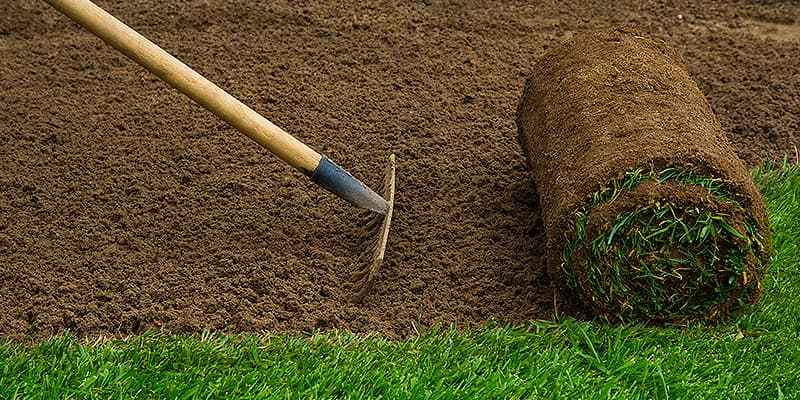
Step 2: Laying the turf
Now that your ground is fully prepared, it’s time for the exciting part: laying your turf.
Remember to lay turf immediately
Turf is a living product and should be laid as soon as possible after delivery. Our turf rolls are harvested to order, giving you complete peace of mind that you will only receive fresh, high-quality lawn turf from Berkshire Turf. Freshly cut turf establishes faster, roots more effectively, and gives you the best possible start for a healthy lawn.
We deliver across Berkshire and surrounding areas, including Oxford and London, ensuring your turf arrives quickly and in excellent condition, ready to be laid the same day.
Our recommended method for laying turf
The way we recommend laying turf is off planks (scaffold planks or plywood boards), particularly if the soil is wet.
Lay a line of turf, put the plank on the turf, then lay the next line of turf by walking up and down the plank. When a line is complete, just roll the plank over and continue.
It is an unnecessary myth to stagger the joints as is often recommended. The joins grow in and disappear in a relatively short space of time.
You will need to cut some turf to fit. We recommend you use a sharp knife, such as a Stanley knife, for this purpose.
Key turf laying tips
- Butt edges tightly together without overlapping
- Avoid stretching the turf
- Work in straight lines
- Avoid walking directly on freshly laid soil
- Ensure good contact between turf and soil
If needed, gently tap down raised edges to ensure full soil contact.
Step 3: Aftercare – helping your turf establish
Your lawn is now laid, but the job isn’t finished yet.
Watering is key
Watering is the single most important factor in successful turf establishment. To make sure that you don’t overdo it, here’s how to approach it:
- Water immediately after laying
- Ensure water soaks through the turf into the soil beneath
- Keep the turf consistently moist for the first 2–3 weeks
In warm or windy weather, you may need to water daily.
Remember that the turf must not dry out while it is establishing roots!